
Specialized Coverage for Oversize and Overweight Loads
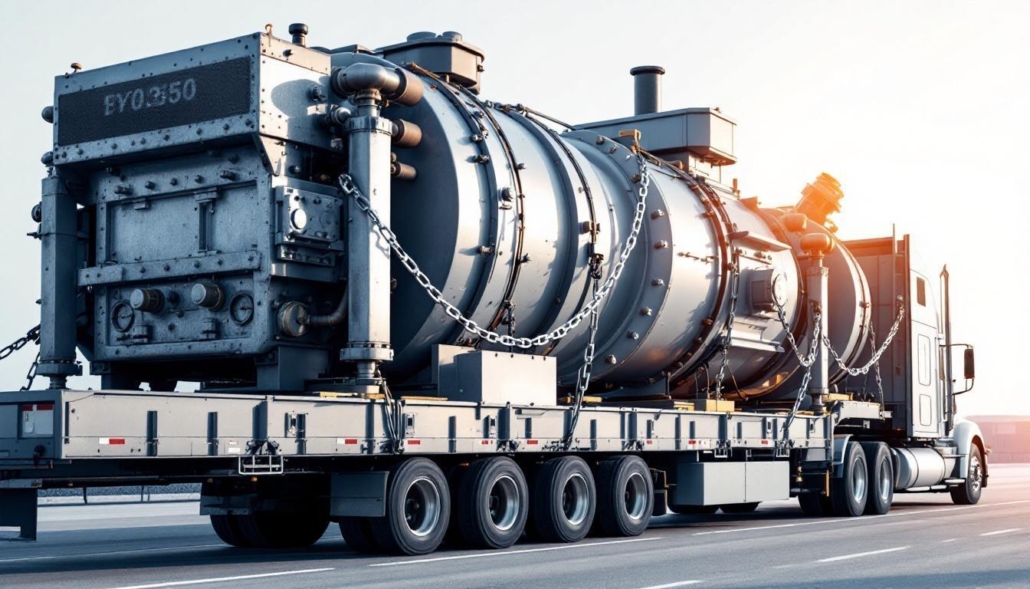
Transporting oversize and overweight loads presents unique challenges that standard trucking insurance simply can’t handle. These specialized operations face higher risks, stricter regulations, and potentially catastrophic liability exposures.
We at Select Risk Insurance Group understand that oversize load insurance requires expertise beyond typical commercial auto coverage. The right protection strategy can mean the difference between a profitable haul and a business-ending claim.
Understanding Oversize and Overweight Load Regulations
Federal Weight and Dimension Standards
The Federal Highway Administration establishes maximum limits at 80,000 pounds gross vehicle weight, 20,000 pounds for single axles, and 34,000 pounds for tandem axles on Interstate highways. Width restrictions cap at 102 inches, while height limits vary by state between 13.5 and 14 feet. These federal standards serve as baselines, but states impose their own stricter requirements that often catch operators off guard. Texas allows up to 125,000 pounds on designated routes, while California restricts many loads to 80,000 pounds with additional axle requirements.
State Permit Systems and Route Planning
Each state operates independent permit systems with different fees, processing times, and restrictions. Michigan charges $15 for basic overweight permits, while New York demands $105 for similar loads. Processing times range from same-day approval in Florida to 10 business days in Pennsylvania.
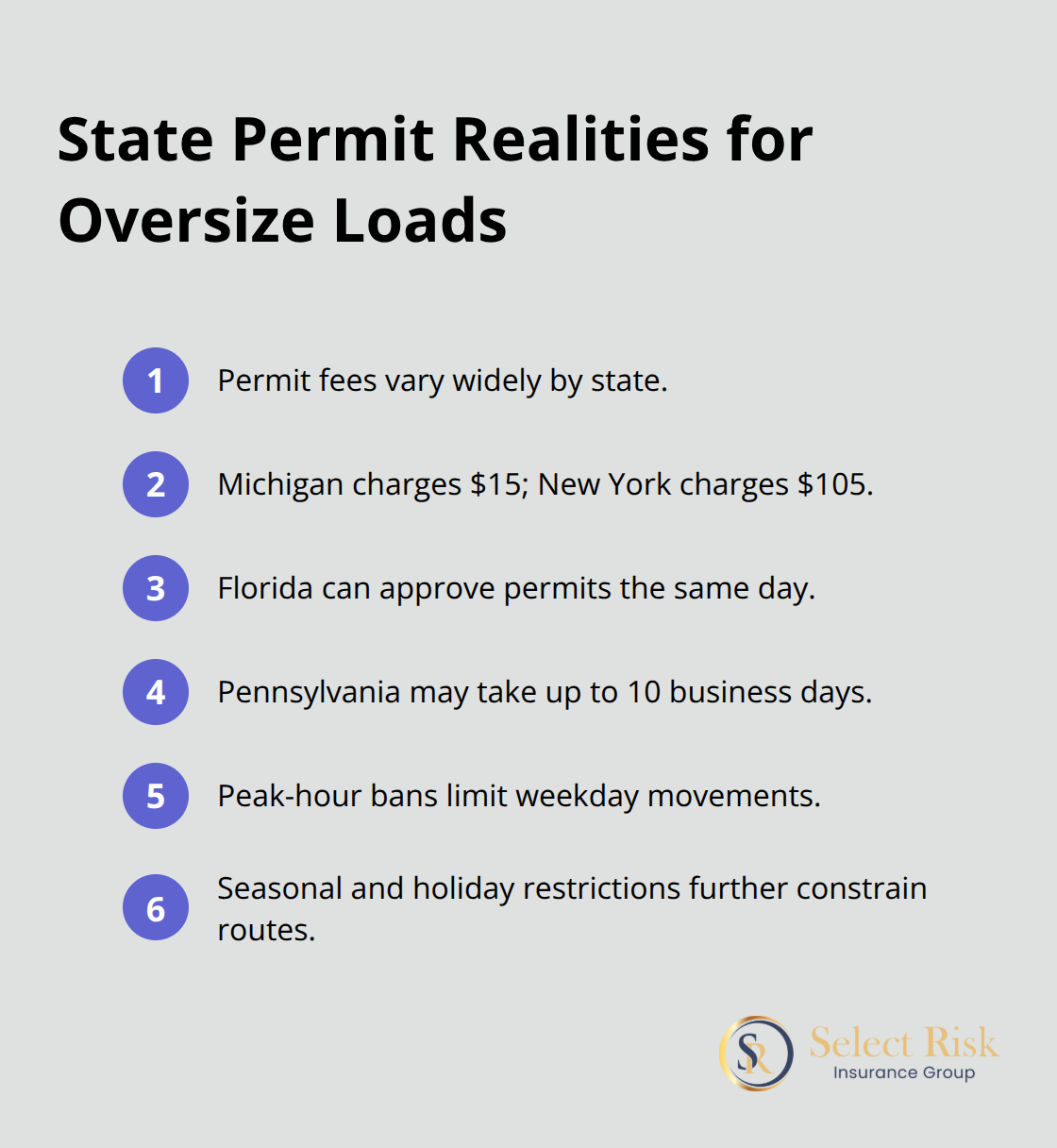
Route restrictions add complexity as states prohibit oversize loads on specific highways during peak hours (typically 6-9 AM and 4-7 PM on weekdays). Wisconsin bans oversize movement entirely during deer hunting season, and several states restrict transport during holiday weekends.
Financial Penalties and Enforcement Actions
Non-compliance penalties escalate rapidly beyond simple fines. Illinois imposes $3,000 fines for operations 10,000 pounds over legal limits, plus $150 per additional 1,000 pounds. Commercial vehicle enforcement officers can issue out-of-service orders that impound equipment until violations resolve. The Federal Motor Carrier Safety Administration assigns Compliance, Safety, Accountability points that increase insurance premiums and trigger additional inspections. Repeat violations result in operating authority suspension, which effectively shuts down carriers for 30-365 days (depending on severity).
These regulatory complexities create significant financial exposures that standard trucking insurance policies cannot address. Specialized coverage becomes essential when carriers face potential claims that exceed typical policy limits.
Insurance Coverage Options for Heavy Haul Operations
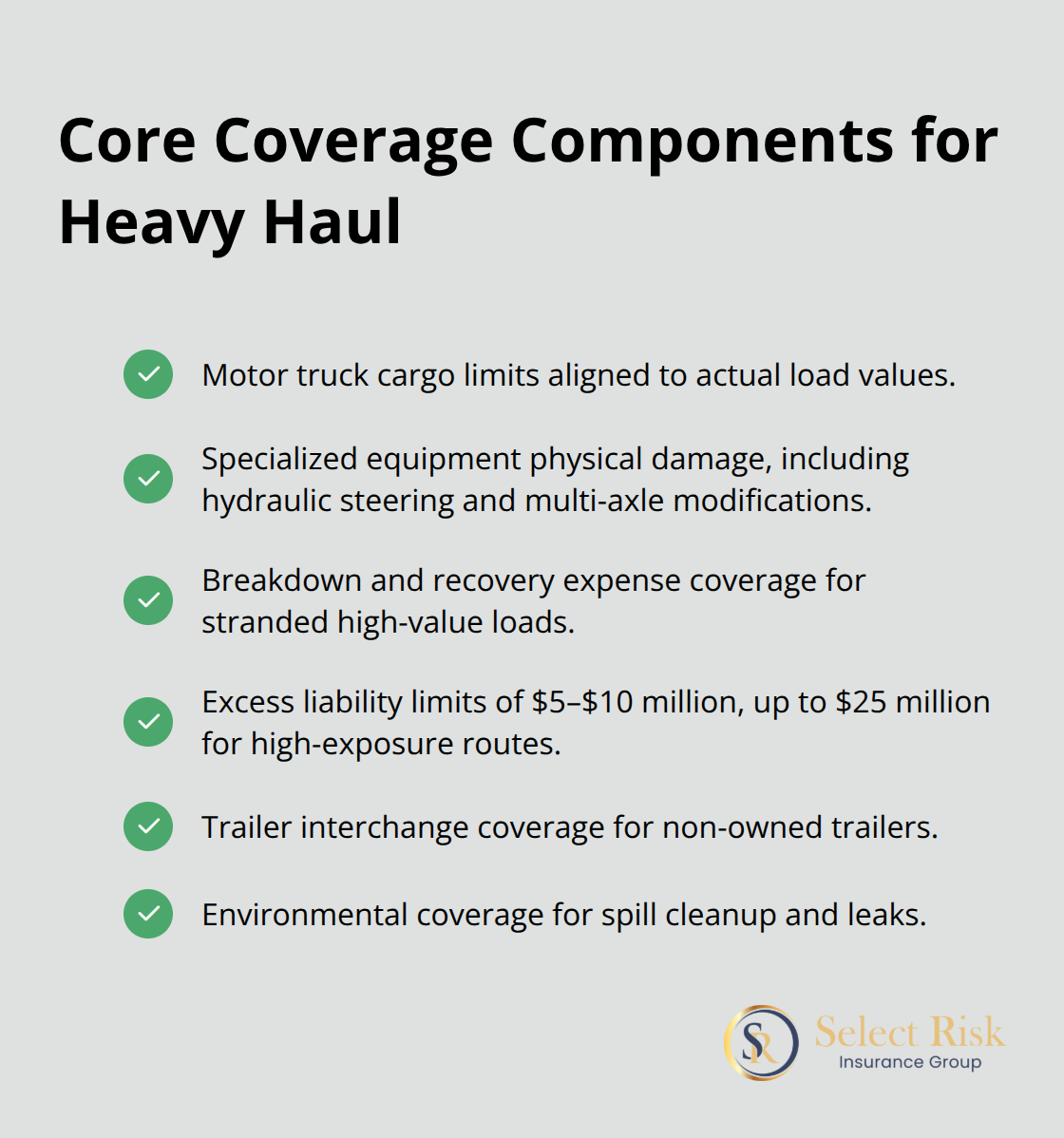
Heavy haul operations demand specialized insurance products that standard trucking policies cannot provide. Motor truck cargo insurance becomes the foundation, requiring coverage limits that reflect actual load values rather than standard freight amounts. Wind turbine components can exceed $2 million per piece, while industrial equipment often reaches $5-10 million in value. Standard cargo policies cap at $100,000, which leaves massive gaps in protection. We recommend minimum cargo coverage of $1 million for most oversize operations, with many operations requiring $5-10 million limits based on typical load values. Inadequate cargo coverage represents a significant risk factor for trucking business failures after major claims.
Specialized Equipment Protection
Specialized equipment coverage addresses the unique exposures of heavy haul trucks and trailers worth $300,000-800,000 each. Standard physical damage policies exclude coverage for specialized modifications like hydraulic steering, outriggers, and multi-axle configurations essential for oversize loads. These modifications represent significant investments that standard policies ignore completely.
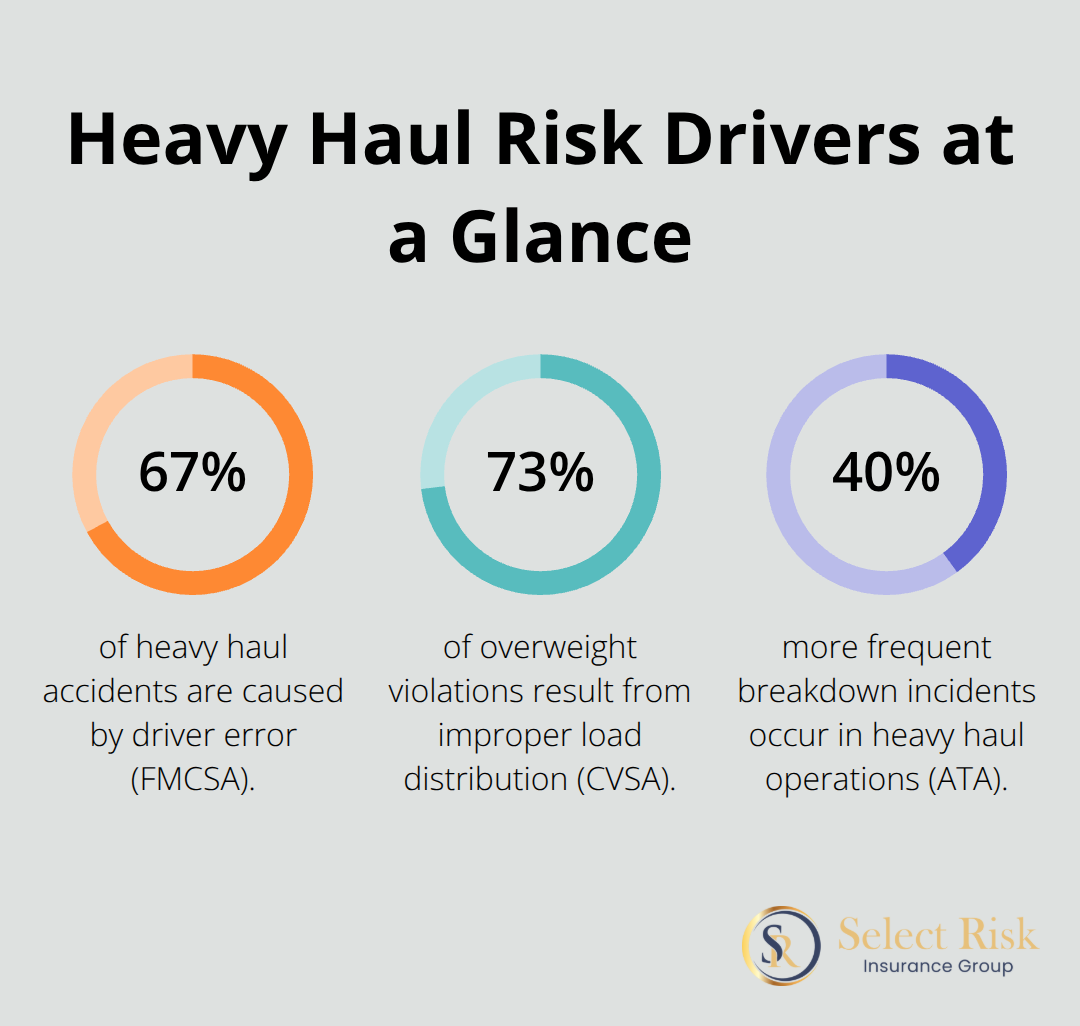
Breakdown protection becomes essential when mechanical failures strand high-value loads in remote locations. Recovery costs for a disabled 200,000-pound load average $75,000-150,000, including specialized towing equipment and road closures. The American Trucking Associations data shows breakdown incidents occur 40% more frequently in heavy haul operations due to increased mechanical stress on components.
Catastrophic Liability Coverage
Excess liability insurance protects against claims that devastate standard $1 million auto liability limits. A single oversize load accident can generate $10-50 million in damages when striking infrastructure or causing multi-vehicle incidents. The Federal Motor Carrier Safety Administration requires $750,000 minimum liability for carriers over 10,001 pounds, but this proves inadequate for heavy haul risks.
Bridge strikes alone average $1.2 million in repair costs according to Federal Highway Administration data, while overpass collapses can exceed $25 million (including traffic disruption costs). Smart operators maintain $5-10 million excess liability coverage, with some high-exposure routes demanding $25 million limits to match potential infrastructure replacement costs.
Trailer Interchange and Environmental Coverage
Trailer interchange insurance protects operators when using trailers they don’t own, which happens frequently in heavy haul operations. Environmental coverage addresses spill cleanup costs when transporting hazardous materials or when hydraulic fluids leak during accidents.
These specialized coverage types work together to address the complex risk profile that heavy haul operations face daily. Proper risk management strategies complement this insurance foundation to create comprehensive protection.
Risk Management Strategies for Oversize Load Transportation
Route Analysis and Infrastructure Assessment
Route surveys identify critical hazards before loads leave the yard. Bridge weight ratings, overhead clearances, and road surface conditions determine feasible paths for oversized cargo. Bridge strikes occur when oversize loads damage infrastructure, which proves that conditions change and assumptions destroy profits.
Professional route surveys cost $2,500-5,000 but prevent $1.2 million average bridge damage claims. Height poles mounted on pilot vehicles detect clearance issues 500 feet ahead, while electronic bridge databases update weight restrictions in real-time. Smart operators maintain relationships with state DOT engineers who provide advance notice of construction projects that affect permitted routes.
Equipment Specifications and Load Distribution
Multi-axle trailers distribute weight across 8-20 axles, which reduces individual axle loads below legal limits while carrying 150,000-400,000 pound loads. Hydraulic suspension systems adjust ride height dynamically and maintain optimal ground clearance on uneven surfaces.
The Commercial Vehicle Safety Alliance data shows that 73% of overweight violations result from improper load distribution rather than excessive gross weight. Proper securement requires one tie-down per 10 feet of cargo length plus additional restraints based on weight. Chain grades matter significantly – Grade 70 transport chain provides 11,300 pound work limits while Grade 43 utility chain fails at 5,400 pounds (a dangerous difference that operators must understand). Electronic load systems alert drivers to cargo shifts before securement failures occur.
Specialized Driver Qualifications
Heavy haul drivers require Commercial Driver’s License endorsements plus specialized training beyond standard requirements. The National Association of Heavy Haul Professionals mandates 40 hours of classroom instruction and 160 hours of supervised driving for certification. Experienced heavy haul drivers command $75,000-95,000 annual salaries due to skill requirements and liability exposure.
Driver error causes 67% of heavy haul accidents according to Federal Motor Carrier Safety Administration statistics, which makes proper training non-negotiable. Simulator programs replicate challenging scenarios like emergency braking with 200,000 pound loads and backing maneuvers in confined spaces. Annual recertification requirements maintain skills while insurance companies offer 15-25% premium discounts for certified operators (a significant cost savings that justifies the investment).
Final Thoughts
Heavy haul operations face complex risks that demand specialized protection beyond standard trucking policies. Oversize load insurance requires coverage limits that match actual cargo values, often reaching $5-10 million for industrial equipment and wind turbine components. The combination of motor truck cargo insurance, specialized equipment coverage, and excess liability protection creates a comprehensive safety net against catastrophic claims.
Experienced insurance providers make the difference between adequate protection and dangerous coverage gaps. We at Select Risk Insurance Group represent multiple carriers to deliver competitive rates on specialized heavy haul coverage. Our team understands the unique challenges that oversize load operators face and provides personalized solutions that protect your business investment.
The next step involves a thorough coverage review with specialized agents who understand heavy haul exposures. Document your typical load values, equipment specifications, and territories to determine appropriate coverage limits (this information helps agents match you with the right carriers). Request quotes from multiple carriers through experienced brokers who maintain relationships with specialized heavy haul insurers.